
FPV Camera Sensor & Lens Selection: Analog, Digital, Thermal
FPV Camera Sensor & Lens Selection: Analog, Digital, Thermal
Direct answer: the correct FPV camera parameter set is the one whose weakest link still meets the mission. A mass-limited night platform on a continuous feed is served by the analog path, where sensitivity and weight dominate. A mission that must record detail, run high frame rates, or feed an AI detection and object-tracking pipeline is served by the digital path, provided the added glass-to-glass delay fits the control loop. A mission where the target is found by heat rather than reflected light is decided by detector resolution, pixel pitch and lens, not by lux. The three worked examples in this guide — IRLAB CDD-BS59KU (analog), CDD-BS5JMU (digital) and CT-EI5ATC (thermal) — show how far apart the resulting parameter sets become when the constraint is chosen first.
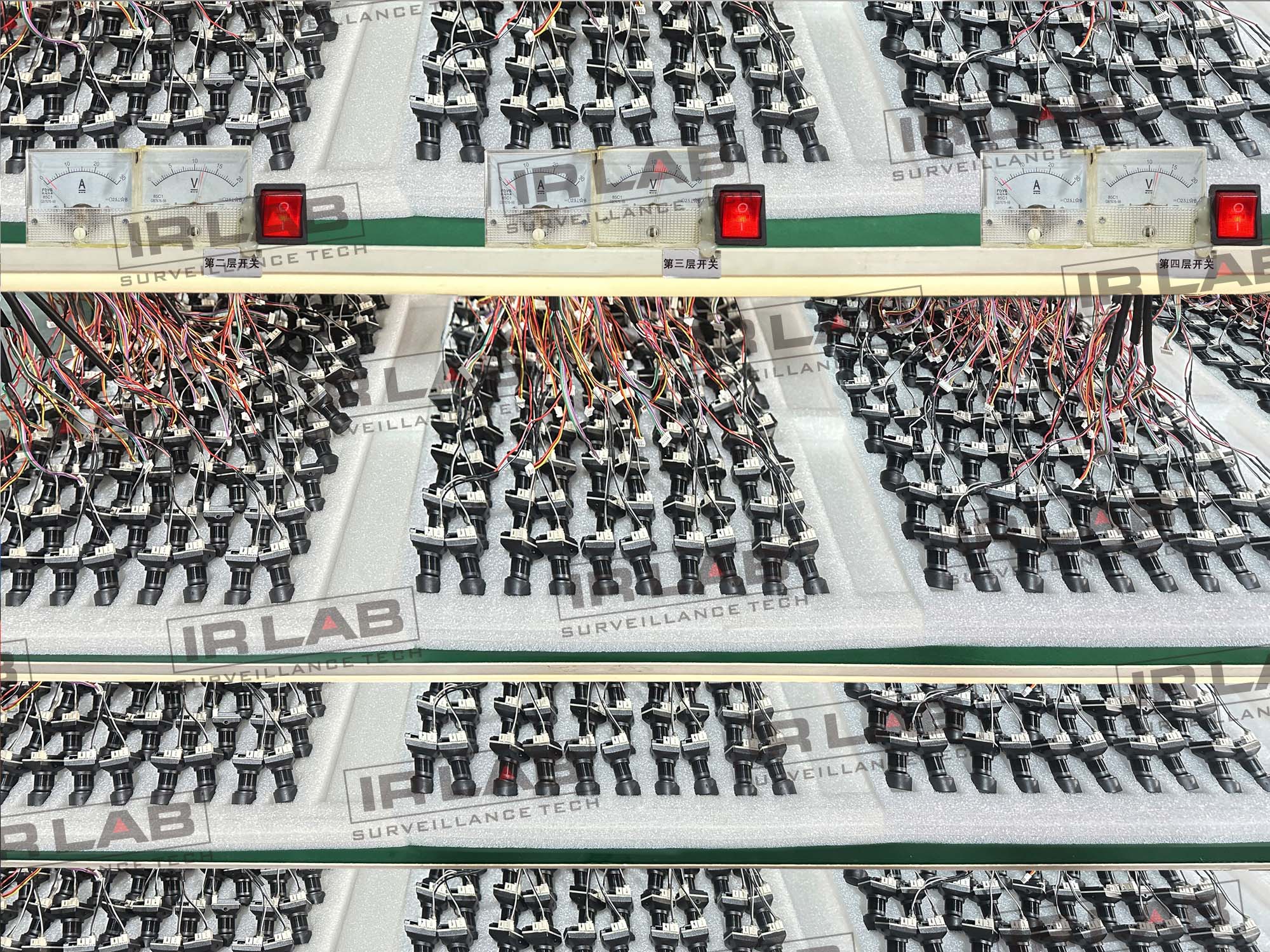
IRLAB Limited is a camera developer and manufacturer founded in Taiwan in 1992 and established in Shenzhen in 2003. The company runs a 3,000 m² facility with 100+ employees, including 10+ engineers, reports an annual output of 6 million camera units, and keeps software, hardware, mechanical structure, video image tuning and quality control in house for its OEM and ODM programmes. Its FPV camera range spans analog, digital HD and thermal units, which makes it a practical reference point for a comparison that has to cross three different imaging technologies.
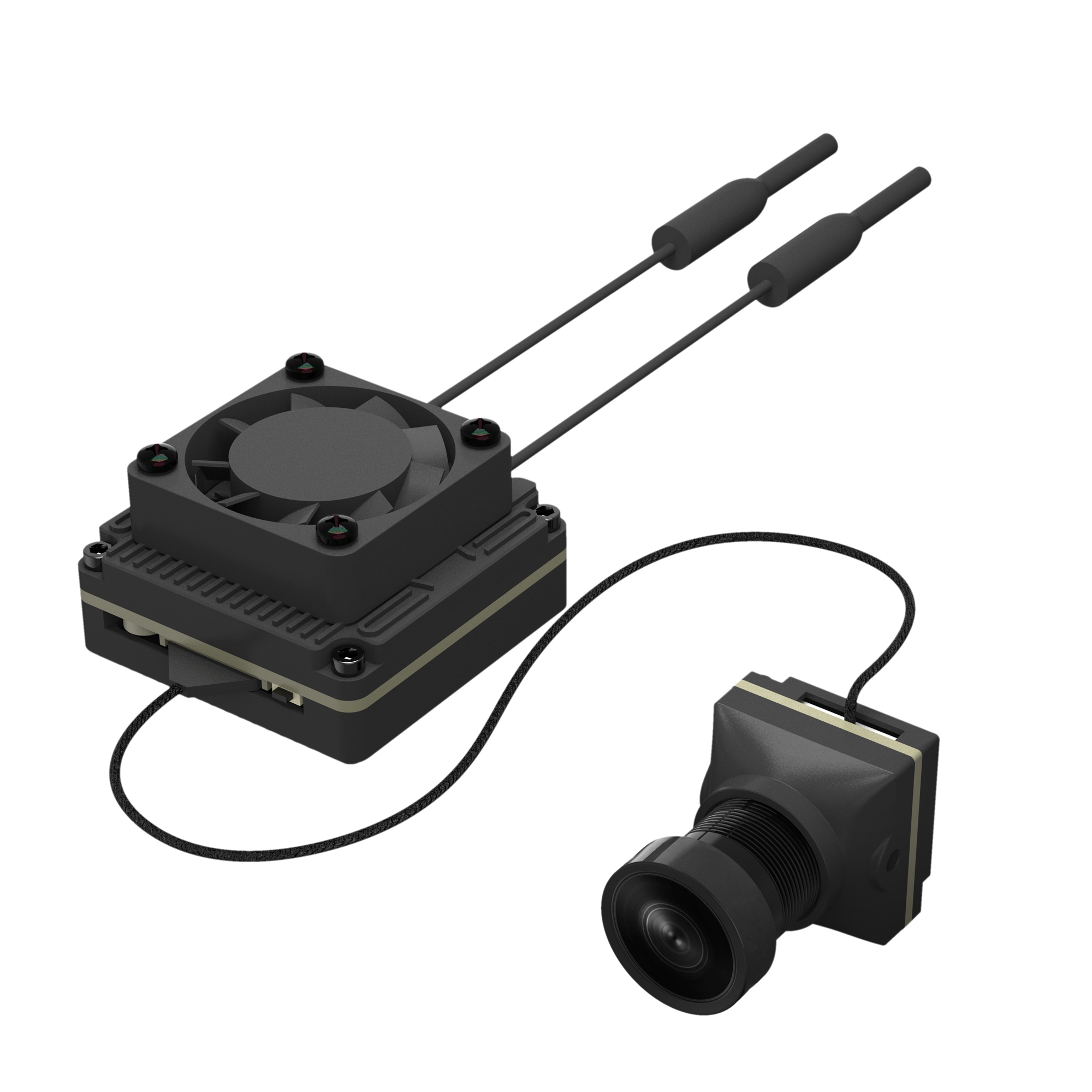
Why FPV Camera Parameters Cannot Be Compared at Face Value
Most FPV camera comparisons place unlike measurements in the same column and then rank them. That is where procurement mistakes start. Each headline number answers a different question, and several of them are only valid inside conditions the datasheet rarely prints.
- TVL is not resolution in pixels. A 1500TVL rating describes how much horizontal detail the analog video path can carry to the transmitter and goggles. It says nothing about the pixel count of the sensor behind it, and it cannot be set against a 3840×2160 mode as if the two were the same unit.
- A minimum-illumination figure needs its conditions. A lux value depends on gain, shutter time, AGC behaviour, lens aperture and the signal-to-noise ratio the vendor is willing to accept. Two cameras quoting the same number can produce very different images at night, so the useful question is which conditions produced the figure.
- Field of view is an output, not an input. Field of view results from focal length and sensor format together. Two cameras both quoting 120° can use different lenses and deliver different angular resolution, so ask for both numbers rather than the angle alone.
- Latency is a system number. Sensor exposure, image processing, encoding, radio link and display each add delay. A camera-level figure is only meaningful when the chain it was measured in is stated.
- Grammes and millimetres change flight behaviour. Mass at the front of a small frame affects balance, vibration and endurance. A 9 g camera in a 19×19×27 mm housing and a 40 g camera in a 25.4×25.4×38.8 mm housing are not interchangeable on the same mount.
- One thermal number never describes detection range. Detector array size, pixel pitch, thermal sensitivity and lens focal length act together. A larger array puts more pixels on a target, but the lens, the sensitivity and the processing decide whether that target is actually resolvable.
The 2026 Context That Changes Parameter Priorities
Three external developments are shaping how buyers weigh sensor and lens parameters in 2026, and each one is attributable to a specific source rather than to general market mood.
Thermal imaging is the fastest-growing application segment in the drone camera market, with a projected compound annual growth rate of 28.1% from 2026 to 2034, according to Straits Research. Growth of that order explains why detector-level parameters — array size, pixel pitch and lens — have moved from specialist discussion into mainstream FPV procurement, and why a thermal unit is now often evaluated alongside, not instead of, a visible-light camera.
On the digital side, commercial research covering 2026 settings places typical glass-to-glass latency for digital FPV systems at 22–40 ms. That band matters because it sets the expectation a supplier's own figure will be judged against: a camera specified at 50 ms glass-to-glass is outside the typical band and should be matched to missions that actually tolerate that delay.
Trade policy is now a parameter too. The United States imposed a 100% Section 232 tariff on unmanned aircraft systems with thermal imaging and certain components starting 3 September 2026, as reported by GHY International with reference to US Customs and Border Protection. For any thermal FPV programme selling into the US market, landed cost and origin documentation belong in the same evaluation sheet as NETD and field of view.
Analog FPV Camera Parameters: CDD-BS59KU
The IRLAB CDD-BS59KU is specified at 1500TVL, 0.00001 lux minimum illumination, a 120° field of view, 9 g mass and a 19×19×27 mm housing. Read as a set, those numbers describe a camera built for a small platform that has to keep flying after the light has gone.
The 1500TVL figure belongs to the analog video path. Its practical value is that the image stays legible through a composite link without the block artefacts and variable delay that encoding introduces, which is why analog remains common on proximity and racing builds where the pilot is flying the picture rather than reviewing it. The trade-off is bounded detail: an analog link cannot deliver the spatial resolution a digital mode can, so tasks that depend on reading small features at distance are a poor fit regardless of TVL.
The 0.00001 lux specification is the parameter that most needs interrogation. At that level the camera is operating in what is usually described as starlight or near-zero-light territory, and the image quality depends heavily on how much gain is applied and how the noise is handled. This is where the design qualities behind the number matter more than the number: high signal-to-noise ratio, low noise floor, wide dynamic range and true colour reproduction are what keep a low-light frame usable instead of turning it into amplified grain. A wide dynamic range also keeps sky and ground detail available in the same frame during dawn, dusk and mixed lighting, and colour fidelity helps an operator identify what they are looking at rather than merely detect that something is there.
Mass and volume are equally part of the specification. At 9 g and 19×19×27 mm, the CDD-BS59KU leaves room on micro and nano class frames where a heavier payload would cost endurance or force a mount redesign. The 120° field of view suits proximity work and situational awareness; it also spreads the available detail across a wide scene, so a buyer who needs to resolve a small object at range should not assume that a wide angle is automatically the better lens.
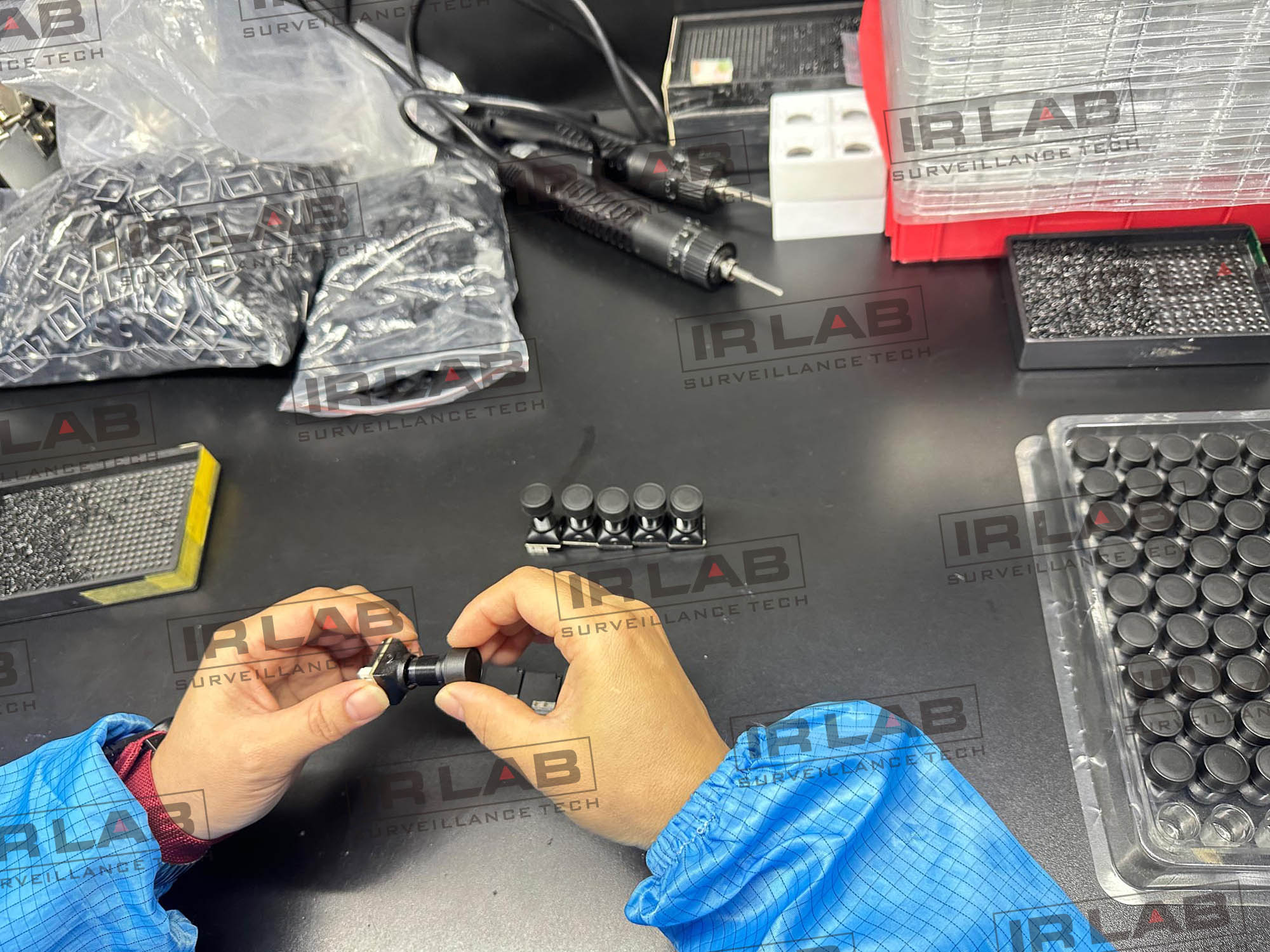
IRLAB has documented one programme that exercised this camera class under severe low light: an FPV drone manufacturer in Ukraine used IRLAB cameras across 30,000 units over one year, and reported that at sensitivity levels as low as 0.00001 lux the platform could identify, lock onto and track targets in extreme low-light or zero-light conditions. That is a single documented customer result under that customer's own operating conditions; it demonstrates what the sensitivity class made possible in one programme and should not be read as a guarantee for a different airframe, lens or video link.
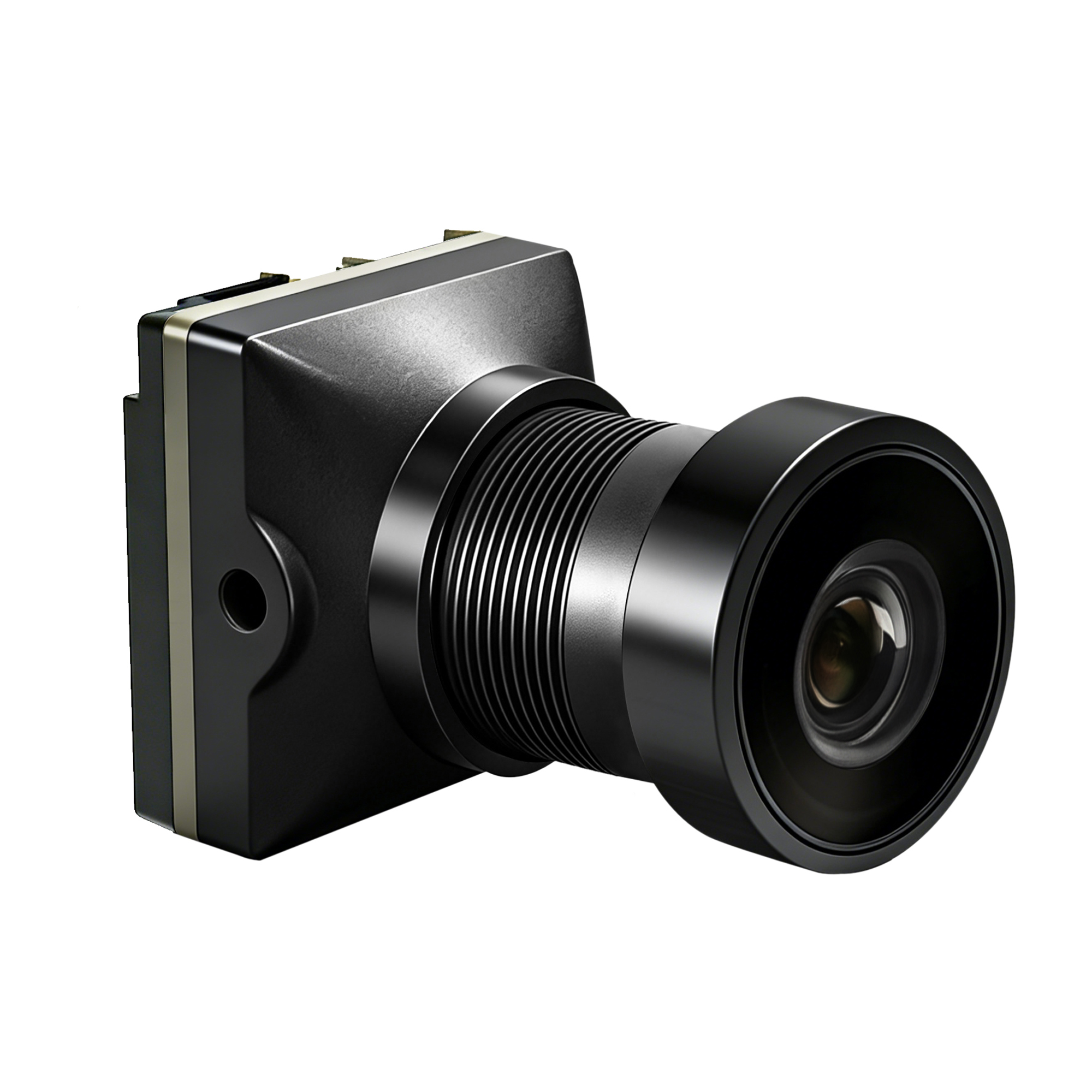
Digital FPV Camera Parameters: CDD-BS5JMU
The IRLAB CDD-BS5JMU uses a Sony sensor and offers three output modes: 3840×2160 at 30 fps, 1080p at 90 fps and 720p at 120 fps, with a 120° field of view and 50 ms glass-to-glass latency. The parameter logic here is a three-way trade between spatial detail, motion handling and delay.
The 3840×2160 at 30 fps mode is the detail mode. It is the setting for inspection, survey and recorded evidence, where a reviewer needs to see structure in a still frame afterwards. The 1080p at 90 fps and 720p at 120 fps modes give up pixel count to reduce motion blur and keep fast movement readable, which is what an operator or a tracking algorithm needs when the scene changes quickly. Choosing between them is a mission decision, not a quality ranking: a survey flight and a pursuit flight want different rows of that list.
Latency deserves separate treatment. At 50 ms glass-to-glass, the CDD-BS5JMU sits above the 22–40 ms band that commercial research associates with typical digital FPV systems in 2026 settings. That does not make the camera unsuitable; it makes the intended use explicit. Missions where the pilot flies close to structures on a live feed, or where a control loop reacts to the image, should test the end-to-end delay with their own transmitter, link and goggles before committing. Missions built around recording, review, or a companion computer that processes frames rather than a human reacting to them have far more tolerance.
The sensor-level qualities carry over from the analog discussion but serve a different purpose. High signal-to-noise ratio and a low noise floor matter twice on a digital camera: once for the human viewer, and once for any detector or tracker consuming the frames. Wide dynamic range preserves detail across bright sky and shaded ground in a single exposure, and true colour reproduction gives colour-based detection and operator identification a stable reference. For teams building an AI detection or object-tracking payload, this is the parameter family to test first, because a detector trained on clean, colour-stable frames degrades quickly when the camera's tone and noise behaviour change between batches.
Digital units are also where OEM integration work concentrates. IRLAB's customization scope includes housing colour, logo printing, alternative viewing-angle lenses, video image style tuning, third-party AI algorithm integration and third-party wireless transmission integration — the last two being the items that usually decide whether a digital camera can be dropped into an existing detection or link architecture.
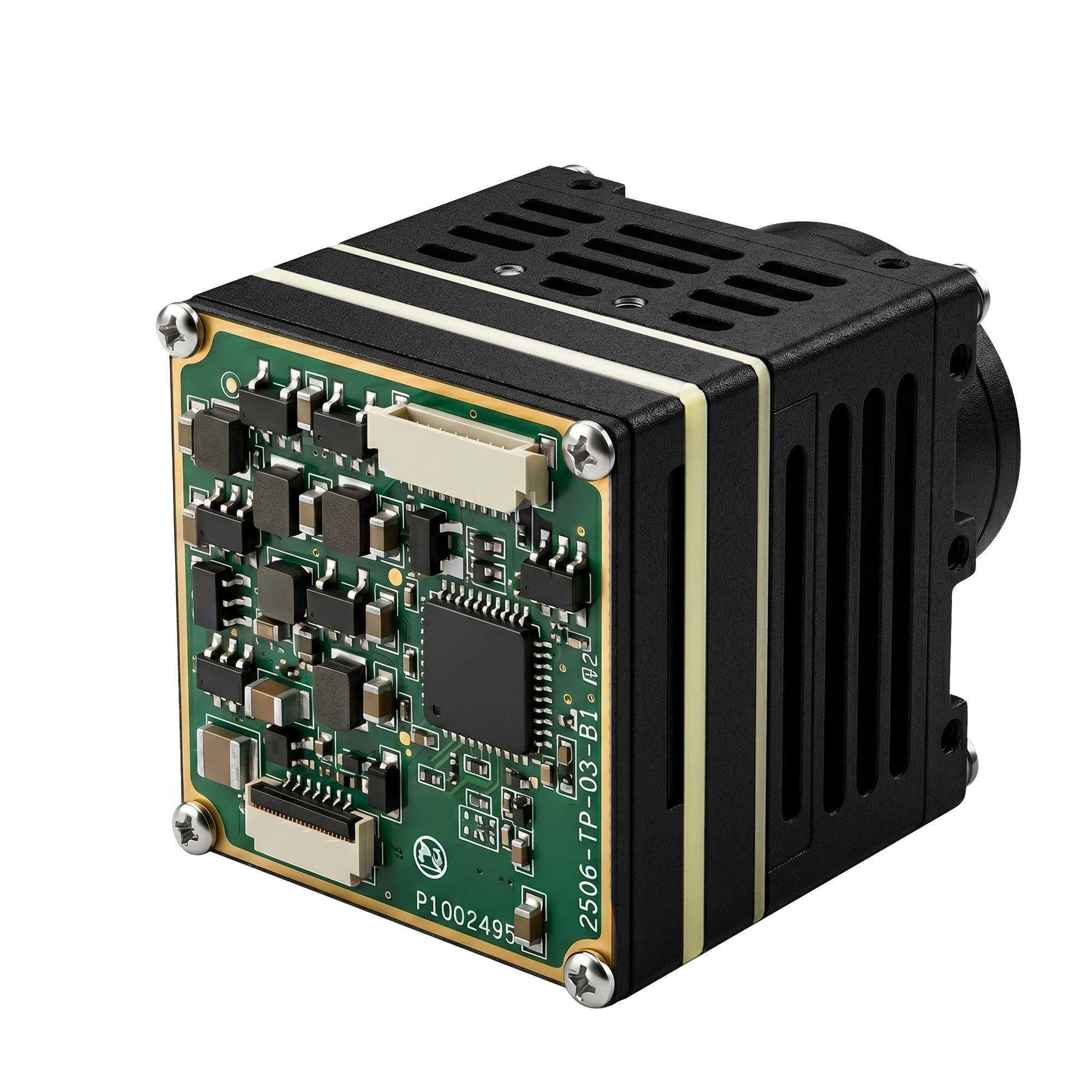
Thermal FPV Camera Parameters: CT-EI5ATC
The IRLAB CT-EI5ATC uses an uncooled vanadium oxide detector with a 640×512 array, weighs 40 g and measures 25.4×25.4×38.8 mm. The word that changes everything in that sentence is 'uncooled': with no cryogenic cooler, the unit starts imaging without a cool-down period and avoids the mass, power draw and complexity a cooled detector would impose on a small airframe.
Detector type is the first parameter to settle. Uncooled microbolometers used in commercial thermal cores are commonly built on vanadium oxide or amorphous silicon absorbers, and both appear in FPV-class products. Detector material alone does not determine image quality; thermal sensitivity, pixel pitch and lens aperture act together with the image processing, so a buyer should ask for the sensitivity figure and the lens specification rather than treating the absorber name as an answer. Within vanadium oxide, the 640×512 array is the meaningful capability statement: more pixels across the scene means more pixels on a target at a given distance, which is what allows recognition rather than mere detection at longer range.
That leads to the calculation that should drive lens choice. A first-order estimate of pixels on target is the ratio of target size to distance, multiplied by the ratio of focal length to pixel pitch, with all four values expressed in consistent units. The estimate is deliberately simple and ignores diffraction, detector fill factor, atmospheric transmission and display losses, but it forces the right conversation: for a given detector, a longer focal length buys pixels on target and costs field of view. A wide lens is the correct choice for piloting and situational awareness; a narrower lens is the correct choice for identification. Very few thermal FPV missions can have both from one lens, which is why dual-FOV or dual-payload arrangements are common.
Environmental specification belongs in the same table. IRLAB's thermal FPV range is described for operation at night and in daylight, across −38 °C to 60 °C, under vibration and shock, in EMI environments, dense fog and torrential rain. The documented role set covers covert night reconnaissance, no-IR tactical manoeuvres, terminal visual guidance, heat-signature locking, search and rescue, and detect-to-engage work. Configuration options in that family include mini FPV thermal, SAR thermal drone camera, industrial survey thermal, tactical thermal, military recon thermal, AI thermal tracking, low-latency analog thermal and RC car thermal builds — a list that shows how much the same detector class is reshaped by housing, lens and interface rather than by the array alone.
A Seven-Step Selection Workflow
The workflow below turns the parameter discussion into a sequence a programme team can actually run, and each step produces a decision record that can be handed to a supplier.
- Write the constraint statement before the specification. Record target size, expected range, light condition, platform mass budget, control-loop timing, environment and destination market. If two of those conflict — a long range and a wide field of view, for example — resolve which one the mission cannot lose. Every later parameter choice follows from that record.
- Set the latency budget and allocate it. Split the total from light to display across exposure, processing, encoding, link and goggles. A camera figure is only one line of that budget; a digital unit specified at 50 ms glass-to-glass should be assessed against the remainder of the chain, not in isolation.
- Choose the imaging band. Select analog when mass and sensitivity dominate and bounded detail is acceptable; digital when recorded detail, higher frame rates or an algorithm feed dominate; thermal when the target is distinguished by heat. Dual-payload builds are a legitimate answer when one band cannot serve both piloting and identification.
- Size the optics against the task. Use the pixels-on-target estimate to test whether the lens puts enough resolution on the object, then confirm the field of view is still flyable. Ask for focal length and sensor format, not just an angle.
- Check mass, volume and mounting. Compare the 9 g and 19×19×27 mm analog housing with the 40 g and 25.4×25.4×38.8 mm thermal housing against your frame, centre of gravity and vibration isolation. Mass added at the nose changes handling more than the number suggests.
- Test the sensitivity and latency claims under your conditions. Obtain a sample, define the measurement conditions, and log the results with your own link and goggles. Treat a minimum-illumination figure as a starting point for that test, not as a conclusion.
- Close the compliance, origin and acceptance file. Match certification scope to the exact model and market, collect origin documentation for the bill of materials, and agree inspection criteria in writing before the first production batch.
Comparison Table: Three Parameter Sets Side by Side
The table below uses only figures stated in the supplied product specifications. Where a value was not stated for a model, it is marked as such rather than estimated, because an absent figure is a question for the supplier, not evidence of a limitation.
| Parameter | Analog CDD-BS59KU | Digital CDD-BS5JMU | Thermal CT-EI5ATC |
|---|---|---|---|
| Imaging path | Analog video | Digital, Sony sensor | Uncooled vanadium oxide thermal detector |
| Resolution / output | 1500TVL | 3840×2160@30fps, 1080p@90fps, 720p@120fps | 640×512 detector array |
| Low-light basis | 0.00001 lux minimum illumination (as specified) | Not stated in the supplied specification — request with test conditions | Detects thermal contrast; does not depend on visible light |
| Field of view | 120° | 120° | Not stated in the supplied specification — lens dependent |
| Latency | Not stated in the supplied specification — confirm end-to-end with your transmitter and goggles | 50 ms glass-to-glass | Not stated in the supplied specification — confirm for the configured unit |
| Mass | 9 g | Not stated in the supplied specification | 40 g |
| Dimensions | 19×19×27 mm | Not stated in the supplied specification | 25.4×25.4×38.8 mm |
| Typical mission fit | Mass-limited night and proximity flight on a continuous feed | Detail recording, high frame rate, AI detection and tracking feeds | Night reconnaissance, search and rescue, heat-signature work |
| Verify before order | Conditions behind the lux figure; latency in your chain | End-to-end delay; noise behaviour across the production batch | Thermal sensitivity figure and lens focal length for your range |
Mission Fit: Three Worked Use Cases
Mass-limited night proximity flight
A small frame with a tight mass budget and a pilot flying on a live feed is the clearest analog case. The 9 g CDD-BS59KU adds little to the nose and its 0.00001 lux specification targets the light conditions that end most daytime-only builds. The 120° field of view supports the pilot's awareness of nearby structure. The condition to accept is bounded detail: this is not the configuration for reading small features at distance.
Survey, inspection and algorithm-driven tracking
Where the deliverable is recorded imagery or a frame stream consumed by software, the digital CDD-BS5JMU is the better starting point. The 3840×2160 mode captures detail for later review, the 1080p at 90 fps and 720p at 120 fps modes reduce motion blur for moving subjects, and the sensor qualities that support clean colour and low noise also support stable detector input. The condition is the 50 ms glass-to-glass figure: teams flying on the image should validate the total delay in their own chain before freezing the configuration.
Night reconnaissance and search and rescue
When the subject may be invisible in reflected light but distinct in heat, no visible-light parameter changes the outcome. The 40 g CT-EI5ATC with its 640×512 detector is specified for night and daylight operation across −38 °C to 60 °C, with vibration, EMI, fog and rain listed as operating conditions — a realistic envelope for search and rescue and reconnaissance work. The condition is optical: the lens has to put enough pixels on the target, and that has to be checked against the required range before the order is placed.
Dual-payload builds
Many programmes solve the conflict by carrying two cameras: a wide visible-light unit for piloting and a thermal or narrow-lens unit for identification. The cost is mass and a second video path; the benefit is that each camera is selected on the parameter that actually limits its job, instead of compromising one unit across two incompatible tasks.
Limits, Verification and Sourcing Checks
Parameter selection is only half of an evaluation-stage decision. The other half is confirming that the specified performance survives the transfer from datasheet to delivered unit, and that the commercial and regulatory file is complete.
Start with sensitivity and latency claims. Ask for the conditions behind any minimum-illumination figure, then reproduce them with your own lens, transmitter and goggles. For a digital camera, measure end-to-end delay rather than accepting a single number, because the 50 ms specification and the 22–40 ms industry band are both camera-chain statements that behave differently once your link is inserted.
Then match certification scope to the exact model and market. IRLAB publishes CE certification under EN 55032 and EN 55035 (certificate NTC2006705EV00), FCC under 47 CFR Part 15 Subpart B Class B (NTC2009742FV00), UKCA under BS EN 55032 and BS EN 55035 (SZNTC2204712EV00), E-MARK E11 under ECE R10 (10R-048329, scoped to vehicle on-board and FPV onboard vehicle cameras), plus RoHS, UL, CTICK and an ISO 9001:2015 quality system certificate issued by TÜV (44100102298, valid 11 November 2024 to 10 November 2027). A certificate held by a manufacturer is not automatically a certificate for the configuration you are buying, so ask for the scope document that names the model.
Origin claims need the same treatment. 'China-free' is a sourcing assertion that has to be supported by documentation for the specific bill of materials, because assembly location and component origin are separate facts. No verified origin dataset was available for this article, and none is implied here. Where export control matters — thermal modules in particular — note that supplier statements about control status are company declarations unless confirmed against a regulator; Teledyne FLIR OEM, for example, publicly describes its infrared modules as ITAR-free, which is a self-declaration rather than a regulatory finding. For US-bound thermal programmes, the 100% Section 232 tariff effective 3 September 2026 should be modelled into landed cost before the configuration is frozen.
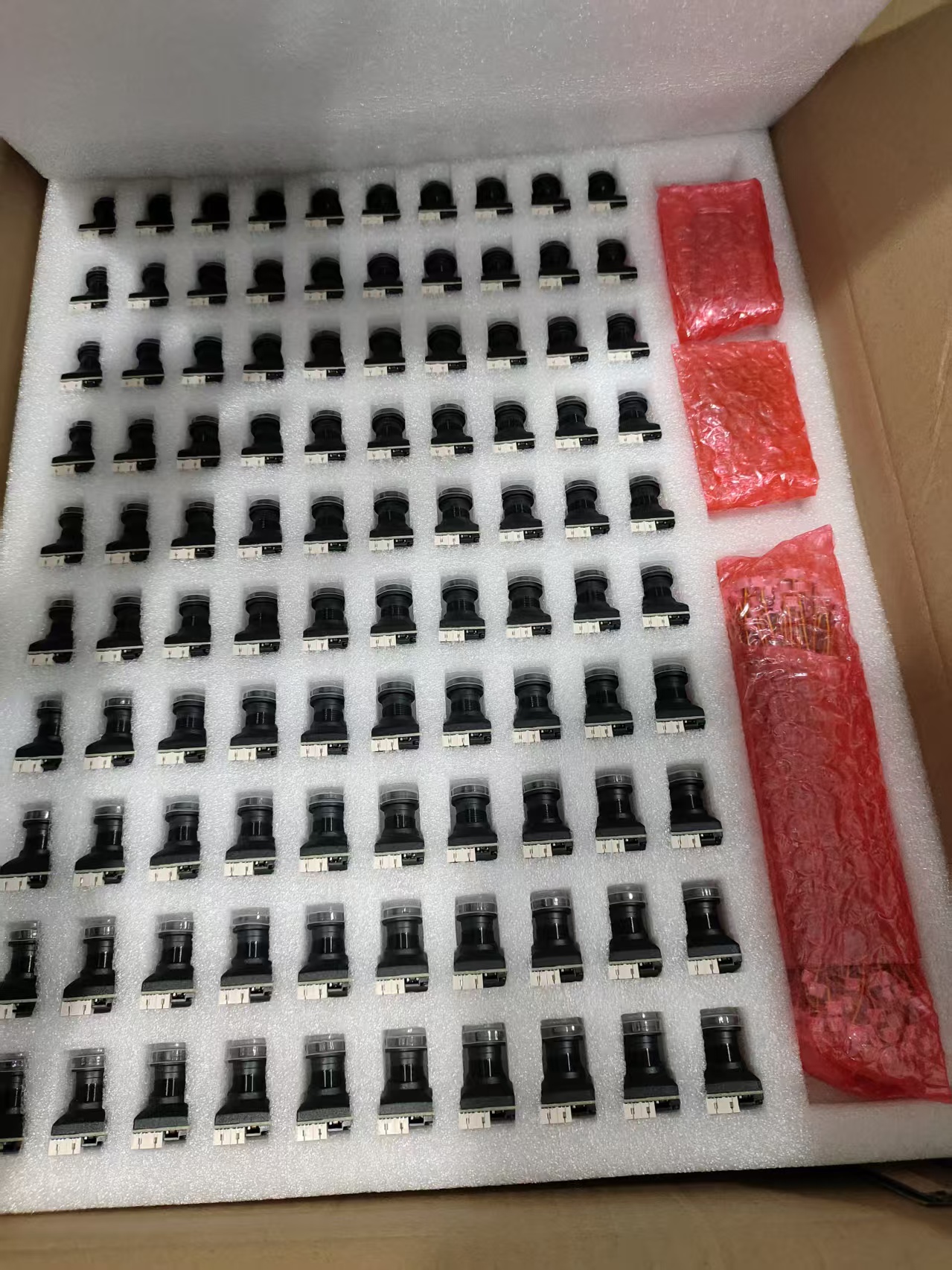
Finally, fix acceptance in writing. IRLAB's standard terms include 100% production check plus AQL-based OQC inspection, a 2-year warranty period, a minimum order quantity of 1 unit, immediate delivery for small quantities and 15–25 working days for large quantities after deposit received, with FCA Shenzhen or C&F Hong Kong delivery terms. Monthly capacity is stated at 500,000 units, which is the figure to check against your ramp plan rather than against a sample order.
Frequently Asked Questions
Which certifications and standards should an FPV camera carry for EU, US, UK and vehicle-mounted projects?
Match the certificate to the market and the mounting. For the EU, CE marking against EN 55032 and EN 55035 is the relevant EMC basis; for the US, FCC under 47 CFR Part 15 Subpart B Class B; for the UK, UKCA against BS EN 55032 and BS EN 55035. Vehicle-mounted installations add E-MARK E11 under ECE R10, whose scope in IRLAB's case covers vehicle on-board and FPV onboard vehicle cameras. RoHS and UL cover material restriction and safety respectively, CTICK covers Australia and New Zealand, and ISO 9001:2015 addresses the quality system rather than the product. Ask for the certificate whose scope names your exact model, and confirm validity dates — IRLAB's ISO certificate runs to 10 November 2027.
Can one FPV camera handle analog low-light flight, 4K recording and thermal detection at the same time?
Not within one sensor and one video path. The CDD-BS59KU delivers a 1500TVL analog image at 0.00001 lux in a 9 g housing; the CDD-BS5JMU delivers digital modes up to 3840×2160 at 30 fps with 50 ms glass-to-glass latency; the CT-EI5ATC images thermal contrast with a 640×512 uncooled vanadium oxide detector and weighs 40 g. Those are three different engineering compromises, not three quality tiers. A programme that needs both piloting awareness and heat detection normally carries two units, or specifies a configuration change — housing, lens, interface or integrated third-party processing — rather than expecting one camera to cover incompatible requirements.
How should a buyer compare cost between analog, digital and thermal FPV cameras?
Compare total landed cost per airframe, not unit price. The comparison should include the camera, its lens, the mount, the video transmission and display hardware it requires, certification and test cost for the destination market, applicable duties such as the US 100% Section 232 tariff on UAS with thermal imaging effective 3 September 2026, and the cost of a failed unit in the field. Analog, digital and thermal units sit in different cost structures because their components differ, so a like-for-like figure only exists once the configuration is identical. A budget alternative is best judged on that total, and on the minimum order quantity that lets you test before scaling — IRLAB's MOQ is 1 unit, which makes a single-sample evaluation practical.
How can a 0.00001 lux or 50 ms glass-to-glass figure be validated before a production order?
Test it in your own chain. For a low-light figure, request the measurement conditions — gain, shutter, AGC behaviour, lens aperture and accepted signal-to-noise threshold — then reproduce a night scene with your lens and video link and inspect the result for usable detail rather than brightness. For latency, measure from a light event at the lens to the image appearing in your goggles, using your transmitter and display, and compare the result with the 50 ms specification. Order a sample first and record the test conditions alongside the result so the production batch can be checked against the same baseline.
What are the ordering, lead time and acceptance terms for an FPV camera programme?
IRLAB's published terms set an MOQ of 1 unit, immediate delivery for small quantities and 15–25 working days for large quantities after the deposit is received, with delivery under FCA Shenzhen or C&F Hong Kong and payment by T/T with 30% deposit on order and 70% balance before shipment. Acceptance is defined as 100% production check plus AQL-standard OQC inspection, and the warranty period is 2 years. Sharing your mission constraints — target, range, light condition, mass budget, destination market — is the fastest way to get a configuration recommendation that matches the parameters discussed in this guide, and the IRLAB company profile and corporate brochure summarises the wider product range.
Conclusion
Sensor and lens selection for an FPV camera is a constraint exercise, not a specification contest. Identify what fails first — light, latency, mass or target contrast — and the parameter set follows: 1500TVL and 0.00001 lux in a 9 g analog housing for mass-limited night flight; a Sony-sensor digital path with 3840×2160 recording, 1080p at 90 fps and 50 ms glass-to-glass for detail and algorithm feeds; a 640×512 uncooled vanadium oxide detector at 40 g for heat-based detection. Every one of those choices carries a condition that should be tested on a sample before production, and every commercial or regulatory claim should be checked against a document rather than a summary.
Next step: bring your mission statement — target size, range, light condition, mass budget and destination market — to IRLAB Limited and request a configuration review or a sample of the analog, digital or thermal unit that matches it. Certificates, test conditions and acceptance terms can be supplied with the quotation.
Download the IRLAB company profile and corporate brochure (PDF)
Have Questions or Need More Details?
Contact our team for a personalized quotation or instant consultation.
Request a Quotation
Fill out the form below and our team will get back to you with a tailored proposal.
WhatsApp Direct Chat
Prefer to chat in real-time? Message us on WhatsApp for instant assistance & quick answers.
- Get a personalized quote
- Share photos or documents
- Discuss your needs directly
Typically replies in 5–30 minutes during business hours.