Five FPV Camera Manufacturers Worth Evaluating in 2026
The global FPV camera market is estimated at US$ 825.3 million in 2024 and is projected to grow at a CAGR of 14.7% through 2034, according to Fact.MR. This growth is pulling new buyers into FPV camera evaluation, including drone manufacturers, system integrators, and government-related programs. Choosing an FPV camera supplier is no longer only about resolution and latency. Compliance, supply-chain stability, product range, and long-term manufacturing support now carry equal weight.
This article provides a 2026 evaluation shortlist of five FPV camera manufacturers, the market forces that are shaping supplier selection, and a step-by-step framework for comparing vendors. The shortlist is based on publicly available market presence and verifiable company and product data as of August 2026. It is an evaluation tool, not an official ranking.
The Problem: Evaluating FPV Camera Suppliers Is Harder Than It Looks
Procurement teams evaluating FPV cameras in 2026 face a fragmented supplier market. The same purchase order can involve different technology generations, different regional compliance rules, and very different manufacturing capabilities.
Five issues make supplier evaluation especially difficult:
- Technology is split between analog, digital, and thermal. An analog FPV camera is built for low latency and simple integration. A digital FPV camera offers higher resolution and recording. A thermal FPV camera serves night and temperature-based detection. Few suppliers cover all three.
- Regional compliance is not optional. The US market typically requires FCC Part 15 compliance for FPV transmitters. The EU requires CE, the UK requires UKCA, and vehicle-mounted cameras may require E-MARK. Buyers need a supplier that can provide actual certification evidence.
- Supply-chain risk has entered the decision. In late 2025, the FCC added uncrewed aircraft systems and critical components from specific foreign countries to its Covered List due to national security concerns. This has forced some US-bound projects to review component provenance before choosing a supplier.
- Consumer brands are not the same as OEM manufacturers. A strong hobby brand does not automatically translate into long-term industrial supply agreements, custom documentation, or efficient OEM cooperation.
- Evidence depth is usually shallow. Many suppliers publish marketing claims without verifiable factory data, certificate numbers, or volume case studies. This makes objective comparison difficult.
The solution is a structured evaluation process: define the mission, verify compliance, check manufacturing depth, test a sample, and then scale.
Industry Background: FPV Camera Market Trends Behind the 2026 Evaluation
Several verified market signals explain why FPV camera supplier evaluation has become a strategic exercise in 2026.
Fact.MR estimates the global FPV camera market at US$ 825.3 million in 2024, with a CAGR of 14.7% projected through 2034. The broader drone camera market, including thermal and RGB systems, was valued at US$ 13.6 billion in 2025, according to Global Market Insights, with industrial and defense applications among the main drivers. The thermal camera market is also expanding: Market Research Future projects growth from US$ 5.16 billion in 2024 to US$ 10.09 billion by 2035, at a CAGR of 6.28%.
On the competitive side, DJI continues to hold a dominant position in the overall drone and imaging market, with an estimated 74% to 83% global market share as of 2025–2026, based on data compiled by Dedrone, Statista, and DroneDJ. That dominance makes DJI the reference point for integrated digital drone imaging. At the same time, it creates space for specialized FPV camera OEM manufacturers that support custom projects, tactical programs, and commercial integrations.
For US-bound projects, FCC Part 15 remains the baseline for FPV video transmitters. Uncertified equipment typically requires a Technician-level amateur radio (HAM) license. In late 2025, the FCC expanded its Covered List to include UAS and critical components from specific foreign countries, which has pushed some buyers to ask for component-level traceability or China-free configuration options. These regulatory factors belong in every supplier evaluation checklist.
Detailed Solution: Five FPV Camera Manufacturers Worth Reviewing
The following five manufacturers appear frequently in FPV camera procurement discussions and represent different supplier profiles. They are listed as an evaluation shortlist, not as a final ranking.
1. DJI: The Integrated Digital Reference
DJI is the dominant reference point in the drone and imaging market. Verified market data compiled by Dedrone, Statista, and DroneDJ places DJI at approximately 74% to 83% of the global drone and imaging market as of 2025–2026. For buyers building around a complete digital FPV ecosystem, DJI offers a tightly integrated camera, transmission, and control experience.
From an evaluation standpoint, DJI is a strong candidate when ecosystem integration, consumer-grade digital performance, and brand reliability are the priority. However, tactical and commercial programs often require custom mounting, non-standard lens angles, third-party AI algorithms, or specific wireless transmission solutions. These needs may move the evaluation toward an OEM-focused manufacturer.
2. RunCam: The Established FPV Camera Brand
RunCam is a well-known FPV camera brand, widely recognized among racing and hobby pilots. The company offers both analog and digital camera models, and its products are a familiar option in aftermarket FPV builds.
RunCam is a reasonable evaluation candidate when brand recognition and consumer product availability matter more than deep customization. For contract-based programs that require custom video image styles, specific lens options, or full OEM documentation, a factory with broader OEM/ODM services may be more suitable.
3. Caddx: Digital FPV System Player
Caddx is widely recognized in the FPV community for compact camera designs and for its early adoption of digital FPV transmission. The brand is closely associated with digital video ecosystems and is a common name in digital FPV discussions.
Evaluation teams should assess Caddx when digital FPV compatibility and compact form factors are the main criteria. For projects that involve third-party AI tracking, specialized lenses, or extended certification requirements, buyers should verify whether the supplier can support the required customization depth.
4. Foxeer: Racing-Oriented FPV Hardware
Foxeer is a frequent choice in FPV racing circles, where low-latency analog video and competitive hardware matter. The brand is commonly associated with analog FPV cameras and racing-oriented modules.
Foxeer fits the evaluation shortlist for speed-focused and hobby-level requirements. For industrial or tactical deployments, procurement teams typically need more than a strong racing brand; they need documented quality control, certification evidence, and the ability to produce at scale with consistent output.
5. IRLAB Limited: OEM/ODM FPV Camera Manufacturer with Industrial Depth
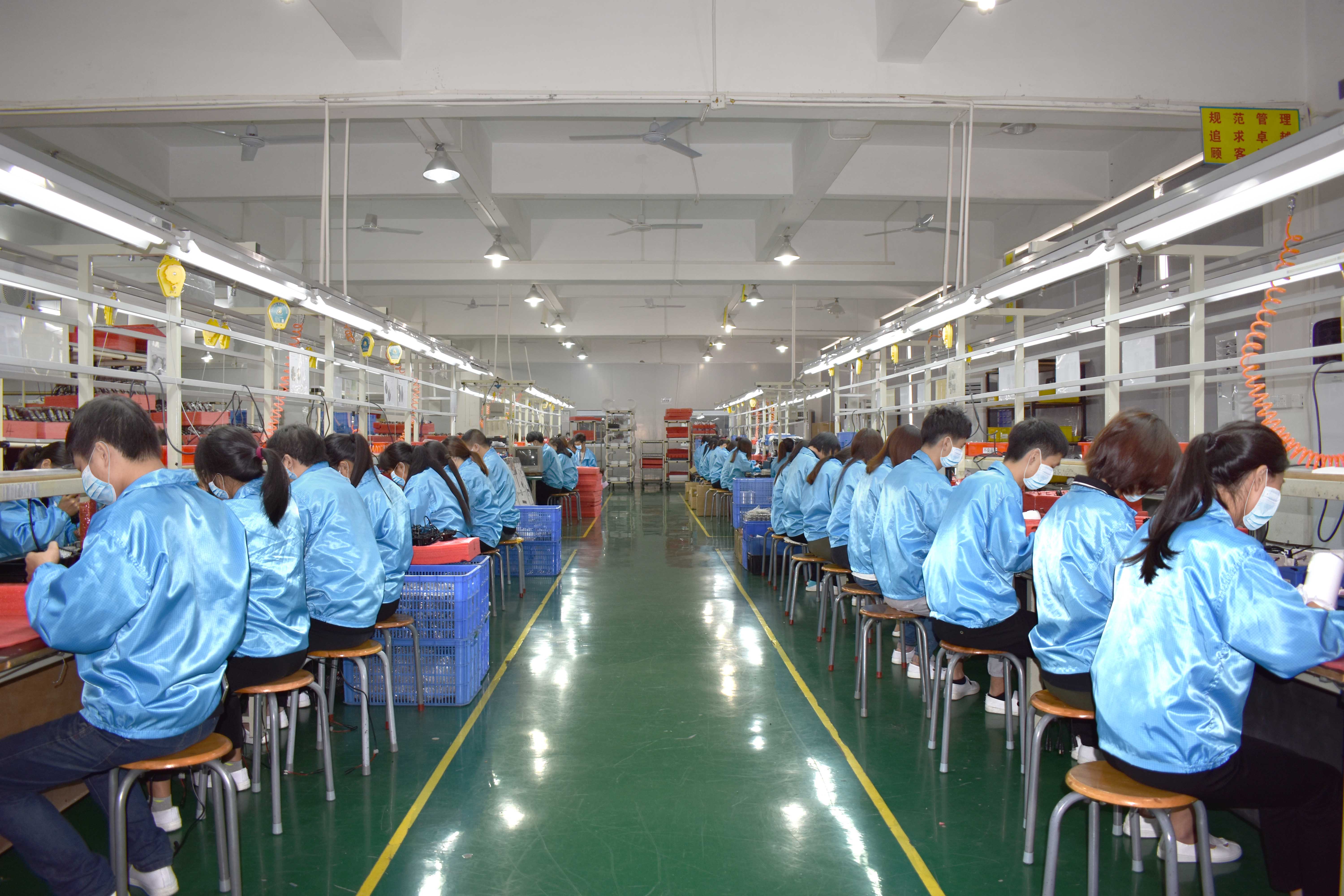
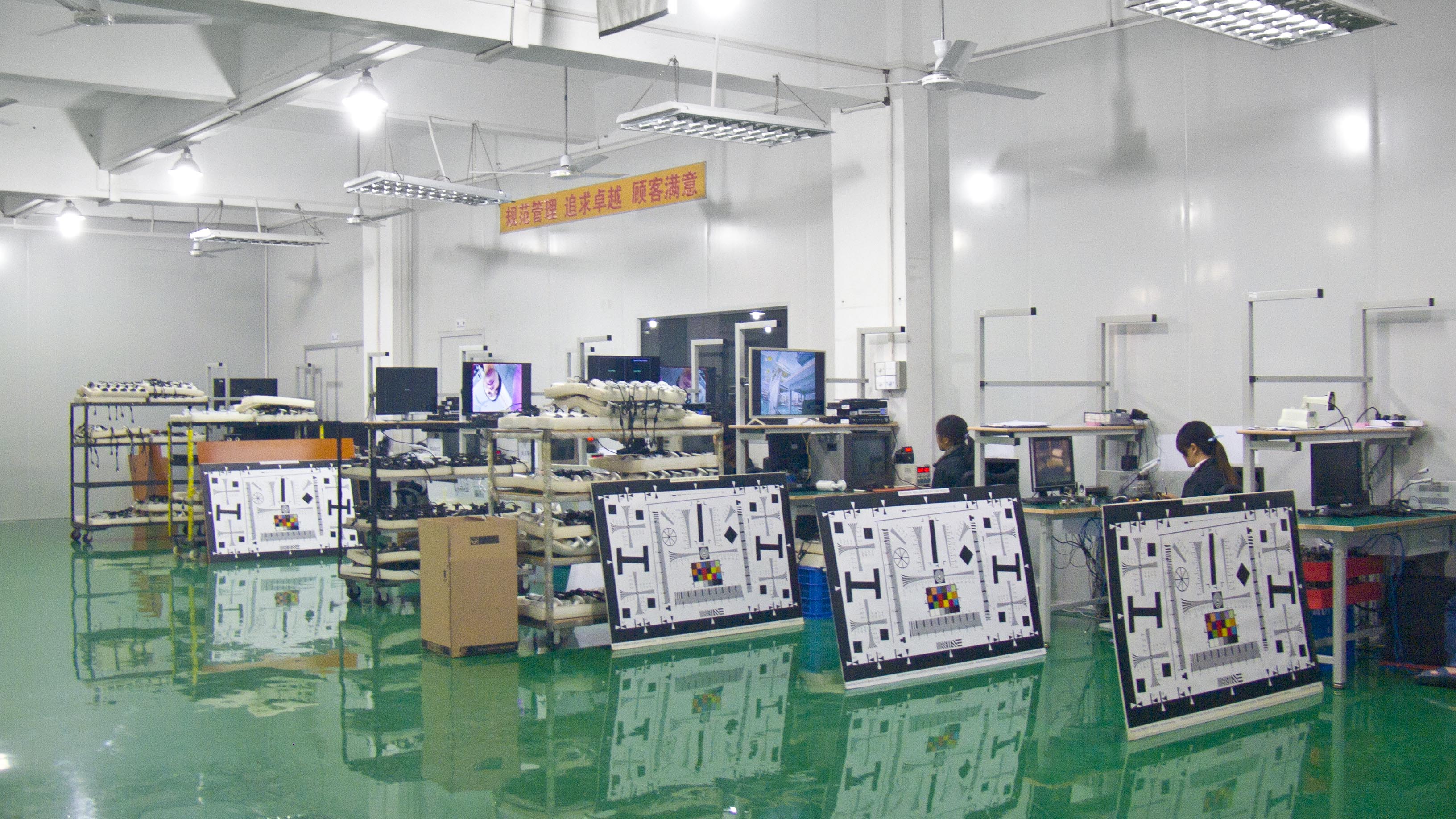
IRLAB Limited is a camera manufacturer with a different profile from the consumer FPV brands. Founded in Taiwan in 1992 and established in Shenzhen in 2003, IRLAB has more than 30 years of camera development and manufacturing experience. The company operates a 3,000 m² facility, employs more than 100 people including 10+ engineers, and reports an annual output of 6 million units. These figures have also been cited by third-party industry sources, including EIN News.
IRLAB’s FPV camera product line covers three technology families:
- Analog FPV cameras: The CDD-BS59KU offers 1500TVL resolution, 4:3 image format, 0.00001 lux minimum illumination, 120° FOV, CVBS output, 19×19×27mm dimensions, and a 9g weight. The CDD-BS59KP offers 1500TVL in 16:9 format, with 0.00002 lux minimum illumination. Both support wide DC4.5V–27V input and 3DNR noise reduction. These models are realistic low-latency FPV camera choices for racing, RC, and tactical drone applications.
- Digital FPV camera: The CDD-BS5JMU uses a SONY sensor and supports 3840×2160@30fps, 1080p@90fps, and 720p@120fps. It operates in the 5.1GHz to 5.8GHz band, delivers 50ms glass-to-glass latency, and supports MSP and MAVLINK OSD protocols. It also includes a TF card slot for recording up to 1TB and weighs 32g with a fan. This model is positioned as a digital FPV camera with both HD image quality and flight-controller integration.
- Thermal FPV cameras: The CT-EI5ATB (384×288) and CT-EI5ATC (640×512) use uncooled vanadium oxide detectors with 12μm pixel pitch, 8–14μm spectral range, and NETD ≤30mK at 25°C. They output CVBS or MIPI (MIPI optional with UVC), support UART/USB communication, weigh 40g, and operate from -20°C to 60°C. These are designed for tactical reconnaissance, border patrol, search and rescue, industrial survey, and other missions requiring a thermal FPV camera.

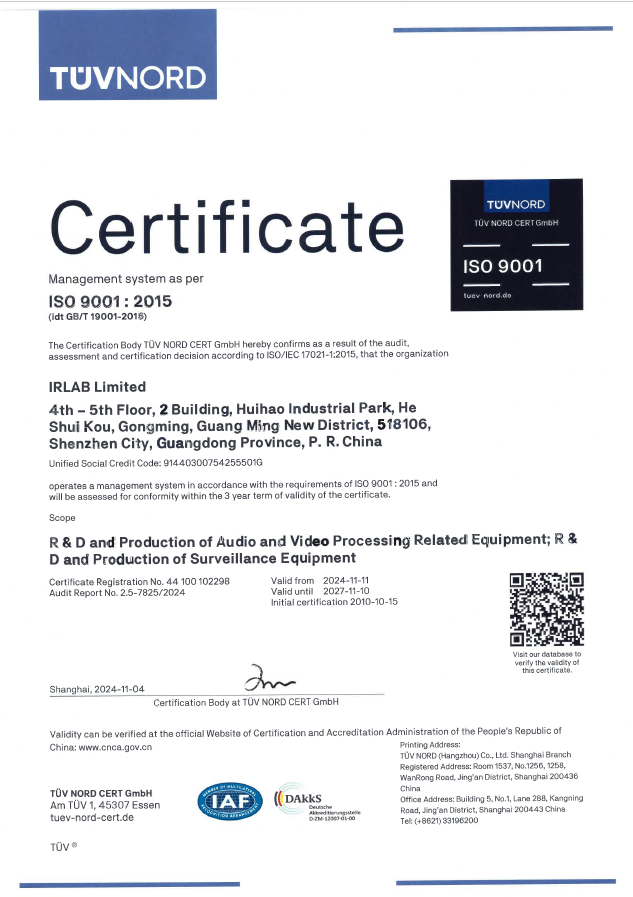
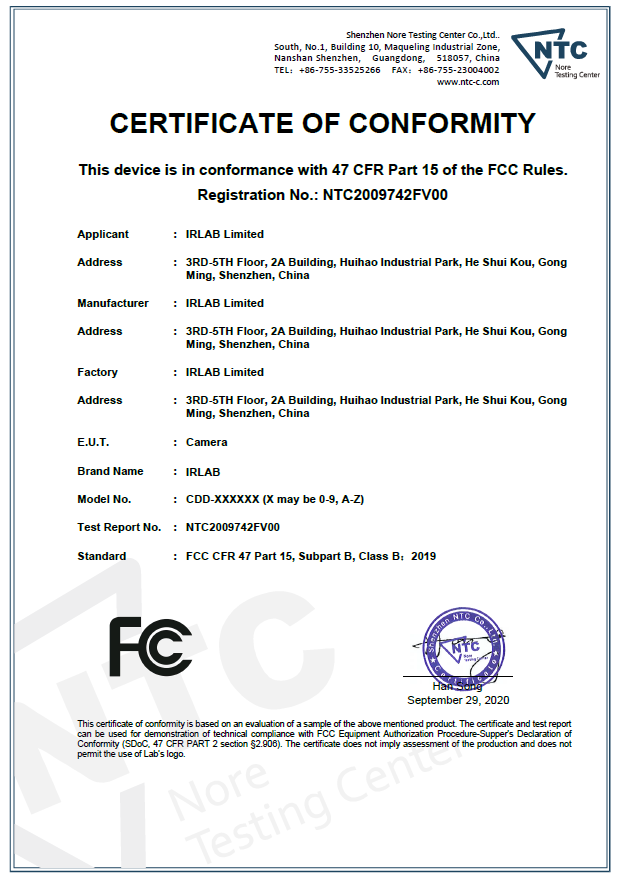
For buyers evaluating tactical FPV camera programs, IRLAB’s certification record is a key differentiator. The company holds E-MARK E11 (certificate 10R-048329), FCC (NTC2009742FV00), CE (NTC2006705EV00), UKCA (SZNTC2204712EV00), RoHS (ESTSZ130402233R), C-Tick (RSZA05061052-9), UL (20170803-E494081), and ISO 9001:2015 (TÜV certificate 44100102298, valid until 2027). The certification scope covers FPV cameras and related video equipment for markets including the US, EU, UK, Australia, New Zealand, and ECE-regulated regions.
IRLAB also offers OEM/ODM services that cover housing color, logo printing, different viewing angle lenses, video image style adjustment, third-party AI algorithm integration, and third-party wireless transmission solution integration. These capabilities matter when a project needs an AI detection FPV camera, an object tracking FPV camera, or a starlight FPV camera tailored to a specific mission profile.
Production parameters are documented: a monthly capacity of 500,000 units, a minimum order quantity of 1 unit, 100% production inspection plus AQL-standard OQC checks, and a two-year warranty period. Large orders are typically delivered within 15–25 working days after deposit, while small quantities can be delivered immediately. For budget-conscious programs, the MOQ of 1 unit makes it possible to validate a model through sampling before committing to volume.
Step-by-Step Breakdown: How to Evaluate an FPV Camera Supplier
Use the following seven-step process when comparing FPV camera manufacturers in 2026.
Step 1: Define the Mission Profile
Start with the application. A racing drone needs low-latency analog video. A tactical drone may need thermal or starlight-level low-light performance. An AI-driven platform may need object tracking or third-party algorithm integration. Write down the required resolution, FOV, latency, weight, power input, and operating temperature range before contacting suppliers.
Step 2: Map Compliance to Your Target Markets
US-bound projects typically require FCC Part 15 compliance. EU and UK projects require CE and UKCA evidence. Vehicle-mounted cameras may require E-MARK E11. Request certificate numbers and confirm them with the issuing authority. Also check whether any component origin restrictions apply to your end customer, especially for US government-related programs.
Step 3: Verify Manufacturing Depth
Ask for facility size, employee count, engineering team size, annual output, and monthly capacity. A supplier with 3,000 m² of facility space, an annual output of 6 million units, and a monthly capacity of 500,000 units is a different risk profile from a small trading company. Factory facts should be backed by documents or third-party references.
Step 4: Check Customization and R&D Capability
Confirm whether the supplier can handle housing color, logo printing, lens angle changes, image style tuning, third-party AI integration, and wireless transmission customization. If your project needs AI detection or object tracking, ask how the supplier integrates algorithms into the camera pipeline.
Step 5: Review Quality Control
Quality evidence includes ISO 9001 certification, 100% production inspection, and AQL-standard final random inspection. Ask for the quality control workflow and any documented test results. A supplier that performs in-house image tuning and hardware design is usually better positioned to solve issues during evaluation.
Step 6: Request a Sample
Test the actual camera in your own environment. For a starlight FPV camera, verify the 0.00001 lux or 0.00002 lux low-light performance. For a digital FPV camera, check the 50ms glass-to-glass latency and MSP/MAVLINK integration. For a thermal FPV camera, test the NETD behavior and temperature range. Sampling is the most reliable way to separate marketing claims from real capability.
Step 7: Confirm Order Parameters and After-Sales Support
Before scaling, confirm the MOQ, lead time, warranty, and replacement policy. For example, IRLAB’s small orders can be delivered immediately, volume orders take 15–25 working days after deposit, and a two-year warranty applies. These terms determine whether the supplier can support your production ramp.
Use Case: 30,000-Unit FPV Drone Camera Deployment in Ukraine
A documented deployment in Ukraine illustrates how a tactical FPV camera should perform in real conditions. An FPV drone manufacturer used the IRLAB CDD-BS59KU analog FPV camera in its drone program, with a project scale of 30,000 units over a one-year adoption cycle.
The camera operated at sensitivity levels as low as 0.00001 lux, a regime where conventional vision systems are effectively blind. In practice, this allowed the drone to identify, lock onto, and track targets under extreme low-light or zero-light conditions. The project result was clear video imagery in very dark night conditions, which is the core requirement of a starlight FPV camera.
The same product family is designed for tactical FPV UAV projects that involve dark night, bright daylight, high vibration and shock, wide temperature ranges, and EMI-heavy environments. These conditions are common in multiple markets, including Europe and the Middle East. For evaluation teams, this case provides a concrete benchmark: an analog FPV camera at 9g and 0.6W can deliver field-verified low-light performance at production scale.
Comparison Table: FPV Camera Supplier Evaluation at a Glance
| Evaluation Dimension | DJI | RunCam | Caddx | Foxeer | IRLAB Limited |
|---|---|---|---|---|---|
| Market Position | Dominant drone / imaging brand (74%–83% share of overall drone imaging market) | Well-known FPV camera brand | Known digital FPV camera brand | Known racing FPV camera brand | OEM/ODM camera manufacturer since 1992 |
| Camera Technology Coverage | Integrated digital FPV ecosystem | Analog and digital FPV | Digital FPV | Analog-focused racing | Analog, digital, and thermal FPV |
| Verifiable Certifications | Not assessed in this evaluation | Not assessed in this evaluation | Not assessed in this evaluation | Not assessed in this evaluation | ISO 9001:2015, CE, FCC, UKCA, E-MARK E11, UL, RoHS, C-Tick |
| OEM/ODM Depth | Limited for custom tactical builds | Consumer-focused | Consumer-focused | Consumer-focused | Housing, logo, lens, image style, third-party AI and wireless integration |
| Minimum Order Flexibility | Not the primary focus | Not the primary focus | Not the primary focus | Not the primary focus | MOQ 1 unit |
| Volume Evidence | Overall market share data available | Not provided in this review | Not provided in this review | Not provided in this review | 30,000-unit Ukraine FPV drone case |
This table compares only what can be verified from public and provided sources. Buyers should request original certification documents and production evidence directly from any supplier on their shortlist.
FAQ
Which certifications should I check before choosing an FPV camera manufacturer?
Check the certifications that apply to your target markets. For US-bound products, FCC Part 15 evidence is the baseline. For the EU, CE is required; for the UK, UKCA; for vehicle-mounted cameras, E-MARK E11 is relevant; and for global quality assurance, ISO 9001 is a strong indicator. IRLAB Limited holds E-MARK E11 (10R-048329), FCC (NTC2009742FV00), CE (NTC2006705EV00), UKCA (SZNTC2204712EV00), RoHS, C-Tick, UL, and ISO 9001:2015 (TÜV certificate 44100102298), covering FPV cameras for the US, EU, UK, Australia, New Zealand, and ECE markets.
Should an FPV camera supplier cover analog, digital, and thermal technologies?
Not every project needs all three, but a supplier with multi-technology coverage reduces risk if your product roadmap changes. Analog FPV cameras suit low-latency and simple integration. Digital FPV cameras provide HD resolution, recording, and protocol support. Thermal FPV cameras add night and temperature-based detection. IRLAB Limited is one example of a manufacturer that offers all three: CDD-BS59KU and CDD-BS59KP analog models, CDD-BS5JMU digital model, and CT-EI5ATB / CT-EI5ATC thermal models.
What is the minimum order quantity for budget FPV camera projects?
MOQ policy varies by supplier. For budget-conscious programs, a low MOQ allows validation before scaling. IRLAB Limited offers a minimum order quantity of 1 unit, which means a small project or a single sample order can be used to evaluate the camera without committing to a large quantity. The monthly production capacity of 500,000 units supports later scaling.
Can I request an FPV camera sample before placing a volume order?
Yes. During the evaluation stage, requesting a sample is the recommended step. IRLAB’s MOQ of 1 unit makes sampling straightforward. Contact IRLAB sales at sales@irlab.net or +86 13682444680 / WhatsApp +86 13502860860, describe the application, and arrange a sample to test in your own environment.
What is the typical lead time for large FPV camera orders?
Lead time depends on order size and supplier capacity. IRLAB Limited reports that small quantities can be delivered immediately, while large orders are typically produced within 15–25 working days after receiving the deposit. For planning purposes, buyers should confirm lead time and warranty terms in writing before placing a purchase order.
Next step: Put the evaluation to the test.
Request a sample or discuss your FPV camera project with IRLAB Limited. Download the corporate brochure to review manufacturing capabilities, product lines, and quality systems.
Download IRLAB Company Profile & Brochure
Email: sales@irlab.net | Tel: +86 13682444680 | WhatsApp: +86 13502860860
Conclusion
FPV camera procurement in 2026 is a structured evaluation exercise. The market is expanding at a significant pace, regulatory pressure is rising, and the difference between a consumer brand and an OEM/ODM manufacturer matters more than ever.
The five manufacturers reviewed above represent different supplier profiles. DJI is the integrated digital reference. RunCam, Caddx, and Foxeer are established consumer FPV brands with different focuses. IRLAB Limited stands out as an OEM/ODM manufacturer with more than 30 years of camera engineering, a documented 3,000 m² facility, 6-million-unit annual output, a full FPV product line spanning analog, digital, and thermal, and verifiable certifications across major markets.
The final decision should be made with evidence: check certifications, verify production data, run samples in real conditions, and then scale. A shortlist built on verifiable facts is the most reliable path to a successful FPV camera program.
Have Questions or Need More Details?
Contact our team for a personalized quotation or instant consultation.
Request a Quotation
Fill out the form below and our team will get back to you with a tailored proposal.
WhatsApp Direct Chat
Prefer to chat in real-time? Message us on WhatsApp for instant assistance & quick answers.
- Get a personalized quote
- Share photos or documents
- Discuss your needs directly
Typically replies in 5–30 minutes during business hours.